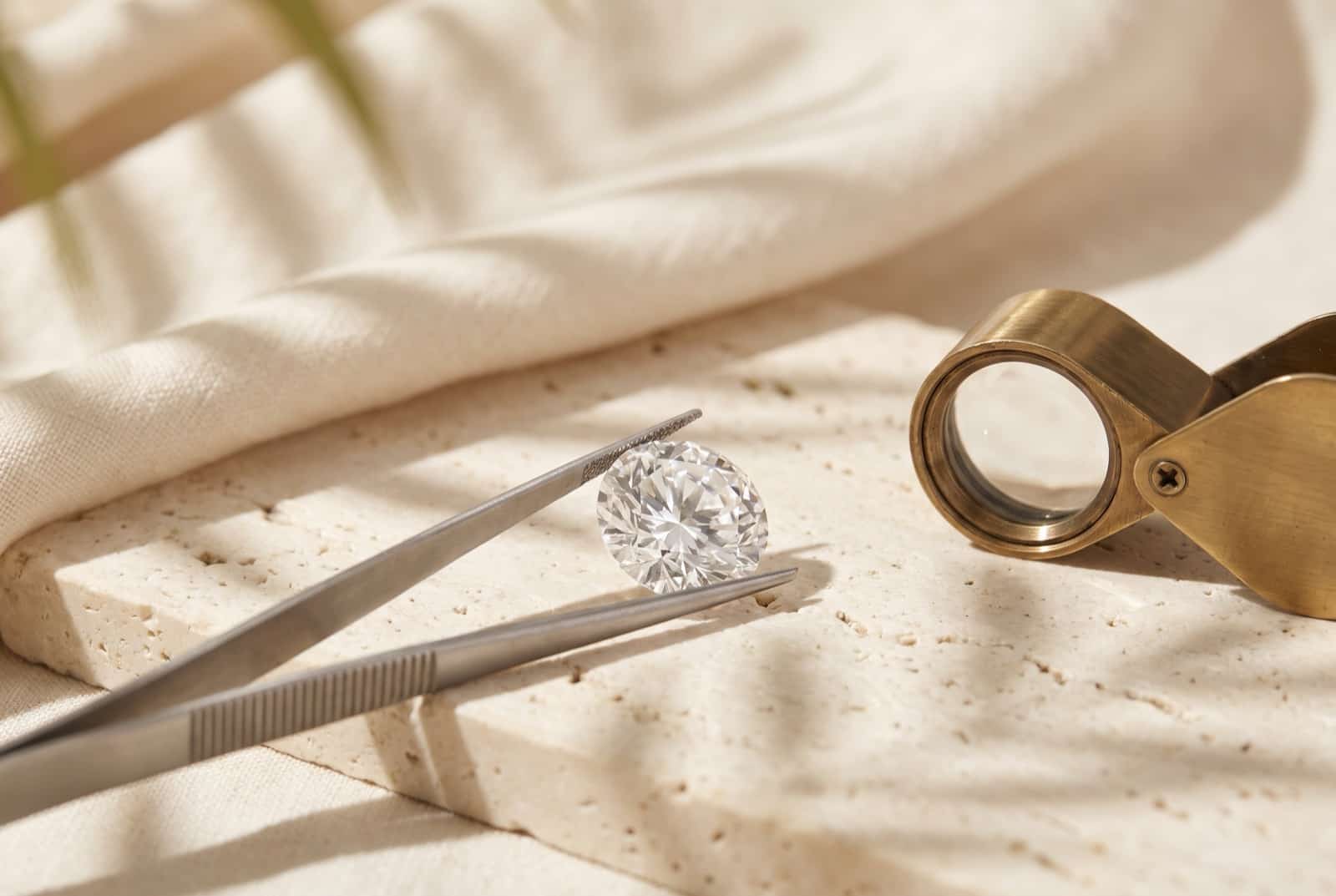
A diamond is graded by four characteristics, the so-called 4 Cs. The term goes back to the GIA, an American gemmological institute that made this system widely known. Today jewellers all over the world use it. Knowing the 4 Cs helps you make a deliberate choice rather than looking at the price alone. Above all, it shows you where you can save a little money without anyone being able to tell by looking at the stone.
Cut
The cut determines how strongly a diamond sparkles. It is the only one of the four criteria shaped by human hands. A diamond sparkles because light is reflected off the polished facets inside the stone and leaves again through the top. When the angles and proportions are right, the stone looks bright and lively. If it is cut too shallow or too deep, light escapes through the bottom.
Grades range from poor to excellent. An excellent cut makes even a smaller stone come alive, while a poor cut leaves even a large diamond looking dull. That is why the cut is the one place where you should try not to compromise.
Cut is not the same as shape. Round, oval, pear or square describes the shape. The cut describes how well that shape has been executed. The classic round diamond with 57 or 58 facets is known as a brilliant.
Colour
The colour scale runs from D (exceptional white) to Z (noticeably tinted, towards yellow). The more colourless a diamond, the rarer and more expensive it is.
For most jewellery the nicest balance of price and effect sits around G to H, a near colourless white that is hard to tell apart from the most expensive grade once set in a ring. A small tip: in a yellow or rose gold setting, a faint tint is even less noticeable than in white gold or platinum. If you love yellow gold, you can often be a little more relaxed about colour.
Clarity
Almost every diamond has tiny inclusions, small natural features from the way it formed. The scale runs from flawless (FL/IF) to inclusions visible to the naked eye (I), with the grades VVS, VS and SI in between.
In the VS to SI1 range inclusions are usually not visible to the naked eye and the value for money is excellent. Flawless stones are very rare and priced accordingly, even though you cannot see the difference when wearing them. What matters more is where an inclusion sits. If it lies near the edge, the setting often hides it.
Carat
One carat equals 0.2 grams. Carat weight describes the mass of the stone, not directly its size. So a 1 carat diamond is not twice as large as a 0.5 carat one, as its diameter grows much more slowly.
Because larger stones are rarer, the price per carat rises disproportionately. Here is a genuine money-saving tip: a diamond just below a round carat mark, say 0.9 rather than 1.0 carat, often looks almost the same size yet costs noticeably less. The difference is barely visible to the naked eye.
How to spend your budget wisely
The four criteria are linked, and no stone has to be perfect on every count. For most customers this order of priorities works well:
- Cut first. It decides the sparkle and therefore how beautiful the stone looks.
- Colour in the G to H range. Near colourless, but clearly better value than D to F.
- Clarity in the VS to SI1 range. Usually clean to the naked eye, with no premium for what you cannot see.
- Carat last. Use what is left of your budget to choose the size. Stones just below round marks are worth a look.
Simply bring along your ideas or your budget, and we will find the stone that gives you the most impact together.
Certificate and documentation
On request, you can receive stones with a certificate from a recognised institute. That way the 4 Cs are documented independently and transparently. This matters even more if a diamond is also meant as a tangible asset. Bear in mind, though, that the resale price is usually well below the purchase price. Keep the certificate safe, as it belongs with the stone.
We show you the stones under the loupe and take the time to explain the accompanying certificate, so you can see exactly what you are paying for.
Loose stones, finished jewellery or a setting of your own
With us you will find certified loose diamonds, finished diamond jewellery such as rings, necklaces, stud earrings and tennis bracelets, and the option of a bespoke setting. You choose the stone and we set it to your wishes, from an engagement ring to a pendant, together with our master goldsmith.
We are happy to show you the differences in the shop, on the stone under the loupe.
Mein Juwelier Ulm
Wengengasse 33 · 89073 Ulm